
01 The problem

And it happens once. No edit, no second version, no test audience. It's the only thing in your budget that you'll put your name to and can't take back. You promised what it would do for your brand. Now it has to.
It becomes a chain of suppliers working from a document that describes your event in outline. Everything left unsaid gets filled in by strangers, in the direction their margin points. We know this, because we've worked with these documents for years.
Your team or event agency represents your brand and tries to carry it across to execution without technical expertise. The tech suppliers, with the expertise, represent themselves and bid against each other. There's a seat at that table with nobody in it, and two things happen because it's empty.
How much stands between your big intro and dead silence? It was already decided, just not by you.
02 THE IDEA

The execution just drifts from the intent one reasonable decision at a time, until the event is a smaller version of itself. That's why ambitious ideas need someone to test them on week 1, when there is still time to build them.
Pure technical capability is available in most markets. The key is to make it serve your brand from the start.
Not more expertise in the room; there is already plenty of that. Someone holding it on your side of the table, early enough for it to still have an effect.
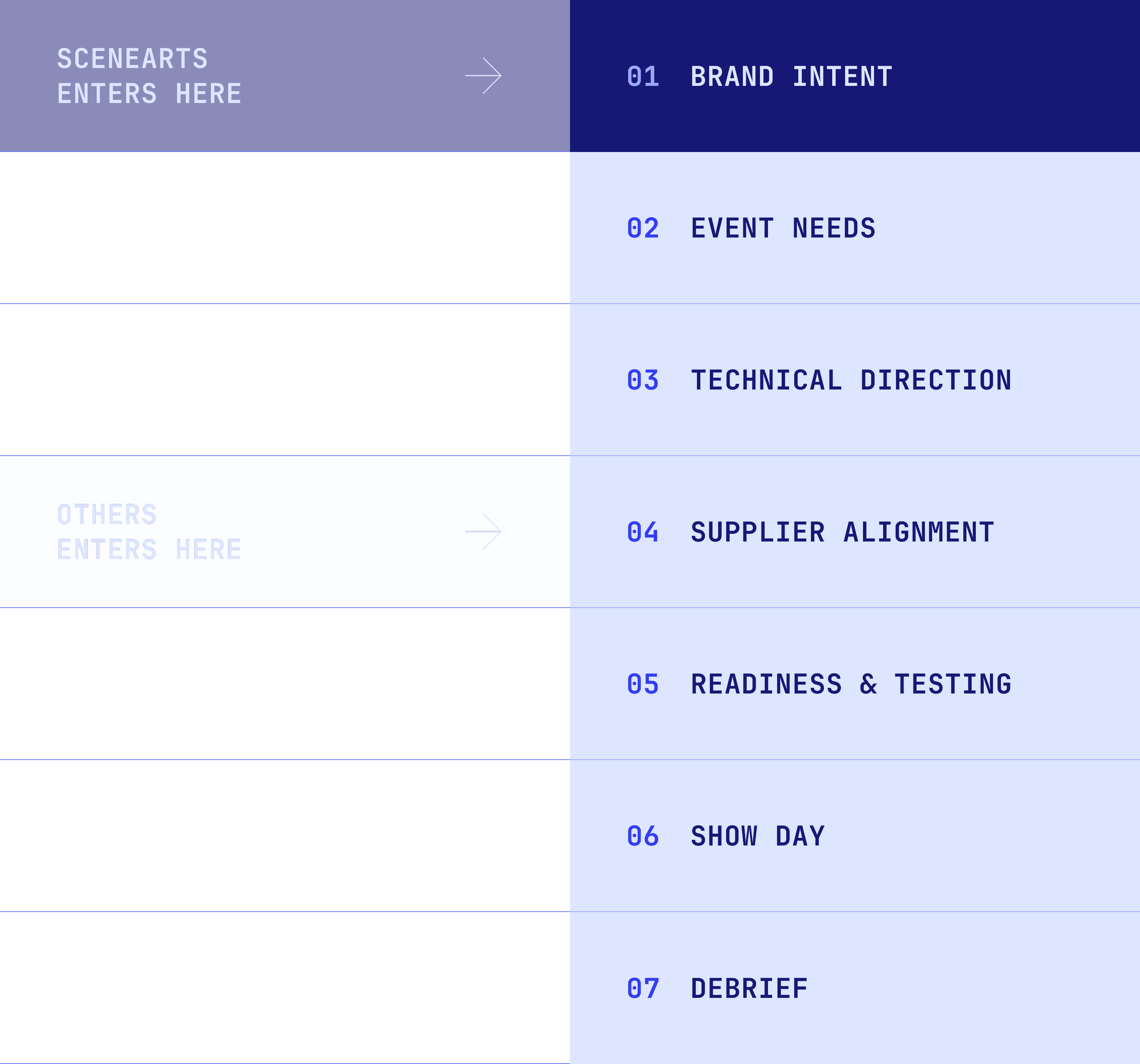
It arrives in steps, and each one is finished in itself. You can stop at any of them still holding something whole.
Combining deep technical knowledge, brand intelligence and international network.


Most event technology suppliers arrive too late to change anything that matters.

03 THE MODEL
01
Blueprint
Learn from one real event before making the big decisions
Blueprint is paid discovery around an upcoming event. We establish what the event is trying to achieve, what is already known, what still needs to be decided and what the technical production will actually require. It replaces assumptions with a usable plan.
You own that answer whether you go further with us, or through another production route entirely.
02
Technical ownership
One event. First plan to live execution.
SceneArts takes responsibility for turning the plan into a working technical production. We make and coordinate the critical technical decisions, write the brief the suppliers work from, qualify who gets the job, align the parties involved and prepare the production for the day. Equipment can come from SceneArts, a venue or local suppliers.
A plan without followthrough is a suggestion
What you meant becomes what's written. What was assumed becomes what's decided. The moments that carry weight become cues, and on the day our people are the ones saying go. Not supervising; operating.
Your brand, live.
You know what you want your audience to feel, believe, and do. We build the technical reality backwards from that.
03
Brand rider
Keep what should survive the event
As events are delivered, useful knowledge begins to accumulate. The Brand Rider is the living standard that captures it. It defines what should stay consistent across events and markets, what can adapt locally, and the operating knowledge that should not need to be rediscovered every time.
It is designed to travel. It can guide us, an agency, a venue or another technical supplier on any individual production.
An artist travels with a tech rider because they're more than a person on a stage
Your brand is more than a logo on a screen. It should travel the same way: with a standard that arrives before you do, and sharpens every time you use it.
Without it, next year isn't a development of this year. It's a different event.
Sometimes that’s exactly what's wanted. But different isn’t the same as better. And when the technical side starts from nothing each time, only the first is available.
04
Ongoing partnership
Put the standard to work
We maintain and develop the Brand Rider and apply it across the agreed event programme. New events start from an existing understanding rather than an empty page. Each event also feeds something back: what worked, what changed and what should become standard from now on.
The result is not identical events. It is continuity.


WHAT ACCUMULATES
Not equipment. Knowledge.
01
Which moments carry weight for this organisation
02
Which technical decisions matter consistently
03
Which compromises are acceptable
04
What speakers need
05
What different audiences need
06
What should stay fixed across markets
07
What should remain flexible
08
Which suppliers and operating models work well
That is what makes the next event easier to build without making it generic.
The partnership becomes useful when the same organisation runs enough important live events for accumulated knowledge to have value. That may mean different markets, venues, event agencies, local suppliers, internal teams and event formats. The events do not need to look the same. They need a better shared starting point.
Equipment remains flexible
The partnership is built around technical expertise rather than tying you to one equipment inventory. Depending on the event, the technology comes from us, from the venue or from local suppliers. That lets the standard travel without forcing the same production solution into every market.
Who it can work for
Companies are an obvious fit, but the model is not limited to corporate brand teams. It also makes sense for universities, institutions, associations, federations and other organisations with an identity to protect and a recurring live programme to deliver.
The relevant question is simpler: do your events repeat often enough, and matter enough, for continuity to be valuable?
Start wherever the relationship needs to start
For a new organisation, Blueprint is usually the first useful step. For an existing client, or an event that is already defined enough, Technical Ownership can start immediately.

QUESTIONS